The heat was intense and my back was killing me by the time I was crossing the Mississippi River. I had read so much about Vicksburg and I was lucky that it laid right in my trip’s path on my drive to Alabama from Texas. I pulled in and the first thing that you notice immediately is the great arch at the entrance. Then you begin driving through these hills, now a very quiet and beautiful place. I passed several memorials and markers. About every one hundred yards there was a plaque that was marking the Union trench line. After driving for about 20 minutes we arrived at De Golyer Battery. The first open area that starts to reveal the size and scope of the battle and later the siege. I was stunned to see that many of the earth works, the trenches, and battery positions were still there. I can only imagine the ferociousness and overall size of the conflict that took place here. You can feel the weight of this place as you walk around. A true sense of reverence for all the men that fought here.
We then made my way along the trench line to the Wisconsin Memorial, a large marble obelisk standing tall along the old Union trench. Walking around it seeing the names of all the men you begin to feel the personal cost of this battle. So many names. I had walked up the long set of white marble stairs leading to the top looking up at the figures of the troops flanking each side. Walking down again back towards the car I took the opportunity to run over and take a closer look at the Union trench line that the road follows as you drive through the battlefield. The heat was insane so by the time I had run over I was sweating through all my clothes. I took a look at the temperature in the car when I got back in and it was 104 degrees so it was definitely hot for running around but very much worth it.
Next, we drove to the highest point on the battlefield, Fort Hill. I did stop at a few spots on the way up the hill, investigating the Union lines and the different approaches and the earth works creeping towards the Confederate readouts and defenses. It was amazing to see for myself a place I had read so much about. It is easy to tell you are at Fort Hill as you pull off in your truck on the top of the mountain. Overlooking the great Mississippi River and how it bends going into the city of Vicksburg it was very clear why this was one of the most important positions for the Confederates. The heavy artillery could fire directly onto the river and any Union Ironclads making a run on the city.
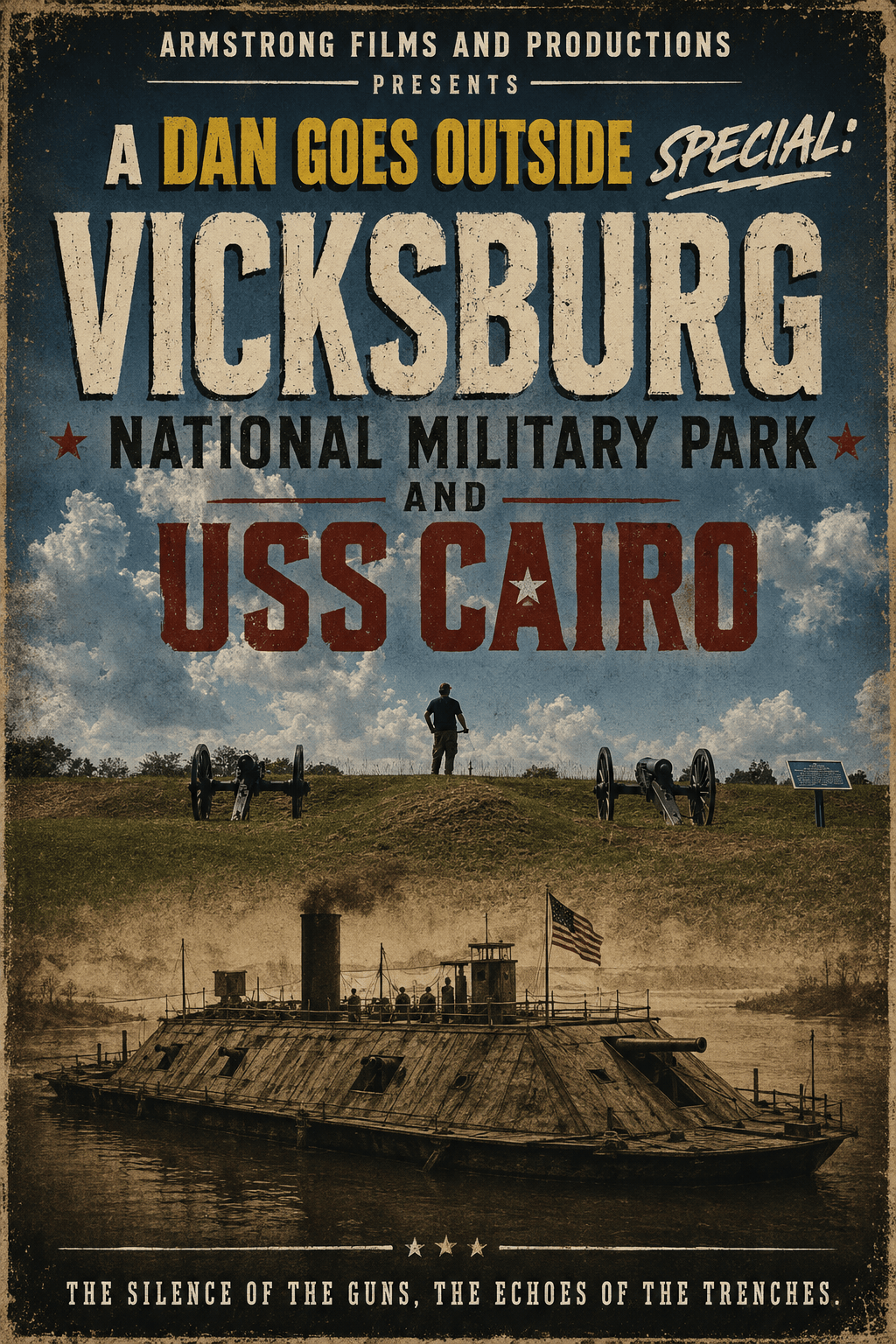
It was getting late in the day so I immediately made my way to one of the most important places of the trip. Time to see the Union Navy Ironclad the Cairo. The first thing that blew me away was the sheer size of the ship. I had only ever seen pictures obviously, since the Cairo is the only ironclad that exists today, the rest being repurposed or dismantled after the war. So, I had never really had an idea of how huge they really were until that moment. In the bow there were two 42 pounder rifles and an 8 inch smoothbore between them. On the Port side three 32 inch smoothbore and an 8 inch smoothbore. The Starboard was equipped with a 42 pounder rifle, an 8 inch smoothbore, and two 32 pound smoothbore. Finally, at the stern of this iron beast of war was a 30 pounder parrot rifle, which is a rifled cannon, on the left and a 32 pounder smoothbore on the right. Seeing this ship of war paddling its way up the river must have been terrifying. Cairo was a paddlewheel steamer like most of the ironclads that fought in the Mississippi River Campaign. Walking through it though was one of the most amazing things I have ever done and as a historian something I can’t believe took me this long to do.
After exploring the great ship I made my way into the Cairo Museum. This amazing part of the Vicksburg National Military Park not only shows the work put into recovering the great ship from where it was sunk by a mine but also shows all the equipment, weapons, and even personal belongings of the sailors on board. It was amazing how the ship acted as a type of time capsule locking everything in how it was when it sunk during the beginning of the siege on December 12, 1862, North of Vicksburg. The video I made of this trip is still the most popular one I have ever made up to now and one of favorites. If you love history or anything maritime this is definitely a location you may want to check out and if you are interested in the history of the Civil War it is most certainly somewhere you may want to wander through for a day or two. Thank you so much for reading friends, God bless you, and don’t forget to go outside!